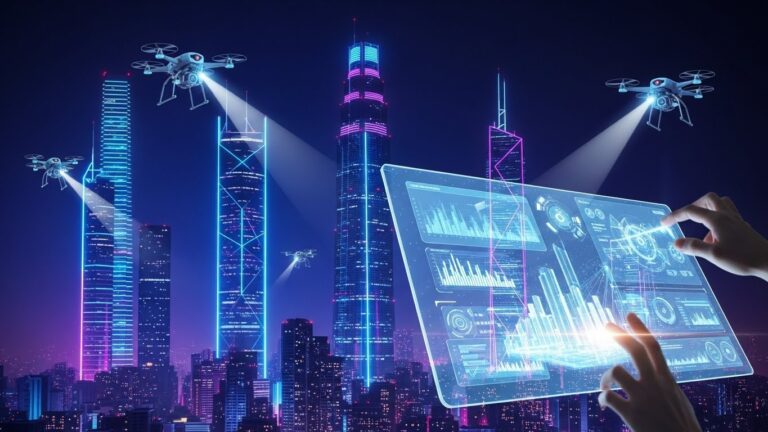
Technology has always been a catalyst for progress, pushing boundaries and changing the way we live. Today, we are witnessing a rapid transformation across all aspects of life—driven by innovations that were once thought to be the stuff of science fiction. From artificial intelligence to quantum computing, new technologies are not only reshaping industries but also our daily experiences. In this blog post, we’ll dive into some of the most exciting emerging technologies and explore how they are revolutionizing the world we know.
Artificial Intelligence: Redefining Human Potential
Artificial intelligence (AI) has already begun to make significant inroads in various sectors, but its true potential is still unfolding. AI is no longer limited to the realm of theoretical research—it’s actively transforming industries like healthcare, finance, and retail. In healthcare, AI-driven systems are helping doctors diagnose diseases faster and more accurately, while predictive algorithms are revolutionizing patient care by anticipating health risks before they become critical.
AI is also enhancing customer experiences in retail, where personalized recommendations based on buying habits and browsing history are becoming the norm. The future of AI looks even more promising as its ability to learn and adapt improves, paving the way for more sophisticated applications in robotics, autonomous vehicles, and even creative fields like music and art generation.
What’s truly exciting about AI is its potential to augment human capabilities rather than replace them. As these systems become more intuitive and capable of handling complex tasks, humans will be freed up to focus on the creative and emotional aspects of work that require a human touch.
Quantum Computing: The New Frontier of Problem-Solving
Quantum computing represents a major leap forward in computing power. Traditional computers process information in binary, using bits to represent either a 0 or a 1. Quantum computers, on the other hand, use quantum bits (qubits) that can exist in multiple states simultaneously, allowing them to perform complex calculations exponentially faster than classical computers.
The impact of quantum computing could be nothing short of revolutionary. Fields like cryptography, drug development, and artificial intelligence stand to benefit enormously. For example, in cryptography, quantum computers could break codes that are currently deemed uncrackable, but they could also create new, more secure encryption methods. In drug discovery, quantum computing could simulate molecular structures and chemical reactions much faster than traditional methods, potentially accelerating the development of life-saving medications.
Although quantum computing is still in its infancy, its rapid evolution means it could be a core technology in just a few years, ushering in a new era of computational power.
Blockchain Technology: Beyond Cryptocurrencies
Blockchain technology, most famously associated with Bitcoin and other cryptocurrencies, is poised to disrupt industries far beyond finance. At its core, blockchain is a decentralized ledger that records transactions in a transparent, secure, and immutable way. It eliminates the need for intermediaries, offering a more direct and trustworthy method of conducting transactions.
One of the most promising applications of blockchain is in supply chain management. By tracking the origin of goods and verifying each step of the production and distribution process, blockchain can reduce fraud and ensure that products are sourced ethically. This could have far-reaching implications in industries like food, pharmaceuticals, and fashion, where transparency is increasingly demanded by consumers.
Blockchain also holds great potential in areas such as healthcare, where patient records could be securely stored and accessed by authorized individuals without the risk of data breaches. Additionally, blockchain-based voting systems could make elections more secure and transparent, helping to restore faith in democratic processes.
The Rise of 5G: Connecting the World Like Never Before
The rollout of 5G networks is one of the most anticipated technological advancements in recent years. With speeds up to 100 times faster than 4G, 5G will not only make mobile internet faster but also revolutionize industries that rely on real-time data transfer, such as autonomous vehicles, telemedicine, and smart cities.
For consumers, 5G means faster downloads, smoother video streaming, and enhanced mobile gaming experiences. But its true impact will be felt in industries that depend on instant communication and data exchange. In healthcare, for instance, 5G could make remote surgeries a reality, allowing doctors to perform procedures on patients in different parts of the world with minimal latency. In transportation, 5G will enable vehicles to communicate with each other and with traffic infrastructure, paving the way for safer and more efficient autonomous transportation systems.
The rapid adoption of 5G will also accelerate the growth of the Internet of Things (IoT), connecting billions of devices—from home appliances to industrial machinery—creating a fully integrated digital ecosystem.
Augmented Reality and Virtual Reality: Blurring the Lines Between Digital and Physical Worlds
Augmented reality (AR) and virtual reality (VR) are technologies that immerse users in digital environments, but they do so in fundamentally different ways. While VR creates fully immersive, computer-generated worlds, AR overlays digital elements onto the real world, enhancing our physical surroundings with interactive information.
In the gaming industry, VR has already made a significant impact, offering players the opportunity to experience games in a completely immersive way. However, AR is arguably poised to become even more widespread, especially in industries like retail and education. In retail, AR allows customers to try on clothes virtually, visualize furniture in their homes, or explore products before purchasing. In education, AR can bring learning to life by adding interactive elements to textbooks or creating virtual labs where students can experiment with scientific concepts.
The potential for VR and AR extends far beyond entertainment. In healthcare, VR is being used for therapeutic purposes, such as helping patients with PTSD or anxiety by exposing them to controlled virtual environments. In architecture, VR is revolutionizing how buildings are designed and experienced before construction begins.
Autonomous Systems: The Future of Transportation and Robotics
The rise of autonomous systems—whether self-driving cars, drones, or robots—marks a new chapter in automation. Self-driving cars, powered by AI, sensors, and advanced algorithms, promise to make transportation safer, more efficient, and more sustainable. With the ability to detect obstacles, follow traffic laws, and communicate with other vehicles, autonomous cars could reduce traffic accidents and congestion while lowering emissions.
Drones are already being used in various industries, from delivering packages to monitoring crops and inspecting infrastructure. As drone technology improves, we can expect even more innovative applications, such as the use of drones in emergency response situations or to deliver medical supplies to remote areas.
Robotics, powered by AI and machine learning, is also making significant strides. Autonomous robots are being used in warehouses, manufacturing plants, and even hospitals to perform repetitive tasks, deliver goods, and assist with surgeries. As robotics technology advances, we’ll see even more integration into everyday life, from personal assistants to collaborative robots working alongside humans.
The Ethical Implications of Emerging Technologies
As technology continues to evolve, it’s essential that we consider the ethical implications of these advancements. Issues such as privacy, security, job displacement, and algorithmic bias are at the forefront of discussions surrounding new technologies.
For example, as AI systems become more pervasive, there are growing concerns about the potential for biases in decision-making processes, whether in hiring, criminal justice, or healthcare. There’s also the issue of data privacy, as more personal information is collected by companies through AI-powered devices and services. The development of policies and regulations to address these concerns will be critical in ensuring that technology is used responsibly and ethically.
Moreover, as automation continues to reshape industries, there are concerns about the displacement of human workers. While new technologies create new job opportunities, they also pose challenges in terms of retraining and ensuring that the workforce can adapt to rapidly changing industries.
Conclusion: The Road Ahead
The future of technology is incredibly exciting, with innovations on the horizon that could reshape every aspect of our lives. From artificial intelligence and quantum computing to blockchain and autonomous systems, the technologies of tomorrow promise to create new opportunities, streamline processes, and solve problems that once seemed insurmountable.
However, as we embrace these advancements, it’s crucial that we approach them with careful consideration of their ethical implications and social impacts. The responsible development and deployment of emerging technologies will play a key role in shaping a future that is not only innovative but also inclusive, sustainable, and just.
In the coming years, we can expect to see a world that is more connected, more efficient, and more intelligent. It’s up to us to navigate this transformative period with both optimism and caution, ensuring that technology serves humanity’s best interests.
About the Author